
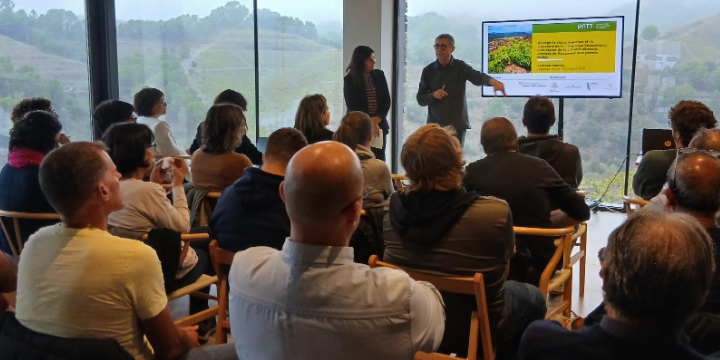
Mas Doix winery hosted yesterday’s technical conference, “Protecting the Vine, Promoting Wine: An Assessment of the Plant Health Campaign and the Challenges of Marketing”. It was organised by the Department of Agriculture, Livestock, Fisheries and Food, with the collaboration of INNOVI, DOQ Priorat, DO Montsant, VITEC and Mas Doix. Part of the PATT 2026 programme, the event included the presentation of the mildew awards and a visit to the host winery’s vineyards.
Anna Lekeunberri Gómez, head of the Plant Health Service, highlighted the low incidence of the main fungal and bacterial diseases affecting grapevines. She also stressed the need to keep monitoring for flavescence dorée following the outbreak in Empordà, as four years without new cases are required for the disease to be considered eradicated.
Ivette Garcia Secall, head of the Agriculture and Plant Health Section in Tarragona, confirmed the low incidence of pests, although the leafhopper appeared in some areas towards the end of the campaign. Treatments were carried out particularly on young vines. Josep Maria Torné, head of viticulture at VITEC, presented trials to control the leafhopper and the European grapevine moth (Lobesia botrana). He noted that the exceptionally early harvest may have helped reduce the incidence of the latter.
The second part of the conference brought together Pilar Just (DO Montsant), Jaume Balaguer (DOQ Priorat), Enric Nart (VITEC) and Valentí Llagostera (Mas Doix) for a roundtable moderated by Eloi Montcada, INNOVI’s cluster manager.
To set the context for the discussion, participants shared data showing that the sector generates more than €3 billion in economic activity and accounts for just under 1.5% of Catalonia’s GDP. More than 98% of companies have fewer than ten employees, and over 60% export. They also pointed to an approximately 15% drop in global wine consumption over eight years and a 41% fall in Spain over fifty years, as well as difficulties in the UK and US markets.
Valentí Llagostera described the current situation as a structural “perfect storm”. Jaume Balaguer highlighted cultural shifts in drinking habits and growing competition from other beverages. The diversity and resilience of the Priorat’s more than 180 small wineries were also emphasised.
Pilar Just championed the role of designations of origin in adding value to wines and helping wineries sell. As examples of promotional activities by her designation, she cited campaigns in markets such as Mexico, Costa Rica, China and South Korea. Enric Nart stressed the importance of understanding consumers better and targeting commercial efforts more effectively.
One of the key points in the discussion was that only 34% of the wine consumed in Catalonia is Catalan. The speakers agreed on the need to strengthen the domestic market, wine tourism and direct sales, with a possible target of 25% of sales, and to review how restaurant mark-ups affect consumption. Better coordination between designations of origin and their commercial messaging was identified as a priority.
The conference highlighted that innovation in promotion and marketing, consumer insight, adding value to the product and collaboration among stakeholders are essential to the future competitiveness of Catalonia’s wine sector. One phrase that resonated throughout the roundtable was: “The key is in our hands. We have to stop complaining and start doing things.”
Comments