
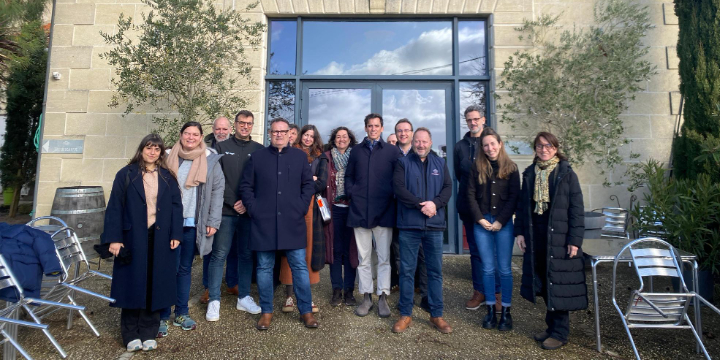
On January 20, 21 and 22, INNOVI organised its first innovation mission, with Bordeaux as the destination. The aim was to bring INNOVI members closer to one of Europe’s most important wine ecosystems at a key moment of transformation for the sector. The mission was carried out within the framework of the European WatEnerWine project.
The mission brought together the wineries Eudald Massana, Vallformosa, Sumarroca and Mas Blanch i Jové, as well as IRTA, Eurecat and ATENS, creating a space for dialogue between wine production, research and applied innovation.
Over the course of three days, participants gained first-hand insight into how the Bordeaux wine sector is addressing challenges very similar to those faced in Catalonia: declining wine consumption, the impact of climate change, labour shortages, and the need to transform both production and commercial models.
The visit to Bordeaux Families, one of the region’s leading cooperatives, provided an opportunity to analyse product diversification strategies, such as the development of crémants and alcohol-free wines, which already account for a significant share of sales. These initiatives illustrate how product innovation can become a key tool for maintaining winegrowers’ profitability.
The mission also focused on technological innovation applied to vineyards and wineries. Through visits to renowned estates such as Château Léoville Las Cases and Château Palmer, participants were able to discover advanced systems for sensor monitoring, fermentation control, gravity-flow winemaking and efficient pump-overs, as well as climate change adaptation strategies based on cover crop management, the integration of livestock and experimentation with biochar.
These visits highlighted that sensor technologies and other innovative tools have become essential for maintaining quality while using fewer resources, particularly in a context of increasing climate pressure and labour shortages.
Another key takeaway from the mission was the recognition that sustainability—environmental, social and economic—is no longer a differentiating factor, but rather a market requirement. Projects such as Château Palmer stand out for combining biodynamic practices with a strong social commitment, including the integration of vulnerable groups and the development of inclusive employment models.
At the same time, wine tourism is becoming firmly established as a strategic tool for diversification and for connecting with new generations of consumers, highlighting the story, the territory and the overall project beyond the final product itself.
The mission made it possible to identify solutions and strategies that can be transferred to the Catalan context and that will serve as a basis for launching new working groups, collaborative projects and innovation initiatives within INNOVI over the coming months.
Comments